
This Children's Day, let's talk about the conversation that could change everything for them, and for you!

Children’s Day is typically filled with gifts, cartoons, outings, and plenty of happy memories. But beyond the fun, it is also a reminder that the habits we teach children today shape the adults they become tomorrow.
One of the most important lessons many children never formally learn is how money works.
In many Nigerian homes, money conversations are often avoided. Parents work hard to provide, children are taught to “manage what you have,” but very few families openly discuss saving, investing, budgeting, or building wealth. For generations, money has felt like something adults worry about privately rather than something children can gradually learn to understand.
The result? Many young adults enter the real world without confidence in managing money, because nobody ever gave them the language to do otherwise. They earn salaries but struggle to save. They spend without planning. They postpone investing because it feels too complicated or “only for rich people.”
But financial confidence does not suddenly appear at age 25. It starts much earlier, with small conversations and everyday habits.
This Children’s Day, perhaps the greatest financial gift parents can give their children is not just money, but financial education.
And for children and teenagers reading this: it is never too early to start learning how money grows.
Money Habits Start Earlier Than We Think
Children are constantly learning from what they see around them. A child who grows up hearing only “money is hard” may become anxious about finances later in life. But a child who learns that money can be planned, saved, invested, and grown develops a healthier relationship with wealth and responsibility.
This does not mean parents need long lectures about finance every weekend.
Sometimes the most powerful lessons are the simplest ones.
The First Conversation is Curiosity Without Shame
When a child asks "Are we rich?" or "Why can't we buy that?", that's not an awkward moment to deflect. That's a door opening. Walk through it.
You don't need a perfect answer. "We make choices about how we use our money, and that's a skill I want to teach you" is more valuable than any toy you'll buy this Children's Day. Children who grow up in homes where money is discussed openly, not performed, not hidden, develop a baseline confidence around finances that peers simply don't have.
The Second Conversation is About the Future, Made Visible
Abstract concepts don't land with children. But numbers do, especially when they're personal.
Try this: Show a child how ₦5,000 saved or invested regularly today could grow into something much bigger by the time they become an adult. That’s when money stops feeling like something you only spend and starts feeling like something you can grow.
And that lesson can change a child’s relationship with money for life.
Here's why it matters so much to start early:
Meet Two Young Savers
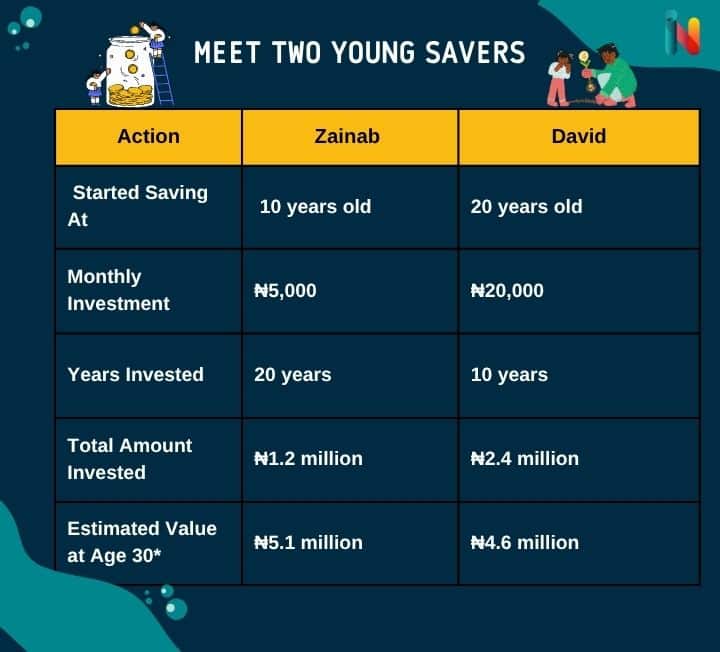
Assumes average annual returns of 15% across a diversified portfolio over time.
What’s the Lesson?
David invested twice as much money. But Amara started earlier.
That extra time gave her investments more opportunity to grow through the power of compounding, where money earns returns, and those returns continue earning returns over time.
The earlier children learn patience, consistency, and long-term thinking, the more powerful their financial future can become.
The child who learns about the power of compounding at 10 will live it at 22. The one who learns it at 30 will spend years making up for what silence cost them.
The Third Conversation is the Practical one, Where Intention Becomes Action
This is where most financial education stalls. The awareness is there, the intention is good, but there's no bridge between knowing and doing. That bridge has to be built at home, with tools that make starting feel possible rather than overwhelming.
Teach them What You Know
Here's something worth sitting with this Children's Day: your children are already learning from you about money. Every time you spend, save, stress, or celebrate a financial win, they're watching. The question isn't whether you're teaching them. It's what you're teaching them.
And here's the reassurance: you don't need to be a financial expert to start. You already understand money in the most important sense, not the textbook sense, but the lived sense.
You know what it feels like to have it and not have it. You've made trade-offs between wants and needs. You may have watched your own parent(s) stretch money to feed a family. You've felt the rush of a salary landing and the anxiety of month-end when it's mostly gone.
Financial literacy is about formalising the vocabulary you already speak; giving names to patterns you've already noticed, and frameworks to decisions you've already been making intuitively.
Smart money talks doesn't mean talking like a fund manager. It means talking with enough clarity and confidence to ask questions before decisions are made, rather than after the wrong ones.
And it means modelling that for the children watching you.
For the Young Readers: This Is Your Invitation
If you're old enough to read this, you're old enough to start.
You don't need to wait for a certain age, a certain salary, or a certain level of certainty. The best investors in the world didn't start with large sums they started with consistent ones.
You can start investing on InvestNaija with ₦1,000. Not ₦100,000. Not when you "have more." Today, with ₦1,000. And the act of starting, of watching even a small amount of money work for you, changes how you think about every Naira you earn from that point forward.
How InvestNaija Makes This Conversation Easier
InvestNaija was built for the moment after the conversation starts. When the question becomes: "Okay, I understand why. But how do I actually begin?"
Start where you are, with what you have. The most paralysing myth in Nigerian financial culture is that you need a certain salary or minimum amount before you can begin. InvestNaija dismantles that myth. Start with ₦1,000 and grow from there.
Clarity over complexity. The app's LearnIN module speaks in plain language — not jargon, not fine print. What is an IPO? Why bonds versus stocks? What does liquidity mean for you? Every product, return, and risk level is explained in terms that don't require a finance degree. For parents teaching children, or young adults teaching themselves, this matters.
Progress that keeps the habit alive. The hardest part of building a financial habit isn't the first deposit. It's the second and the third, when novelty wears off and discipline has to carry the weight. InvestNaija keeps you engaged:
- 📈 Real-time tracking — watch your money grow
- 🎯 PlanIN — set specific goals and see your progress
- 🔄 InvestIN — set it once, and let it build quietly in the background
- 📚 LearnIN — keep educating yourself as your portfolio grows
The Real Gift This Children's Day
Toys fade. Clothes get outgrown. But a child who understands the power of starting early, saving consistently, and asking the right questions about money, that child carries something for life.
This Children's Day, the most powerful thing you can give is a conversation. Start it over breakfast. Start it in the car. Start it imperfectly, honestly, and early.
Then open InvestNaija, together.
Financial confidence is not a destination. It's a conversation you keep having.
Smart money doesn't wait for the perfect moment. It talks its way into one.
Ready to start? Download InvestNaija and open your first investment today from as little as ₦1,000.
Reach out to us on all our social media platforms and let’s share your story with the world! 🌍 OR fill out this quick form: click here. #INVESTinSTORIES | Because everyone has a money story, so what’s yours?
Ready to start your journey? Download the InvestNaija app today from the Apple App Store or Google Play Store. With tools like LearnIN, SaveIN, and InvestIN, you’ll have everything you need to invest confidently and wisely.